

How it works
Discover. Evaluate. Decide. One structured lifecycle.
The short answer
Disqovr runs a software evaluation as seven stages in one place: a stakeholder requirements survey, vendor research against a shared directory, independently scored demos, a structured RFI answered by vendors in their own portal, end-user testing on the finalists, a weighted report that combines all of it, and a post-launch survey that checks the chosen vendor delivered. Every score stays traceable to the person who gave it.
From initial stakeholder requirements all the way through to post-launch validation. Every step purpose-built, every decision traceable.
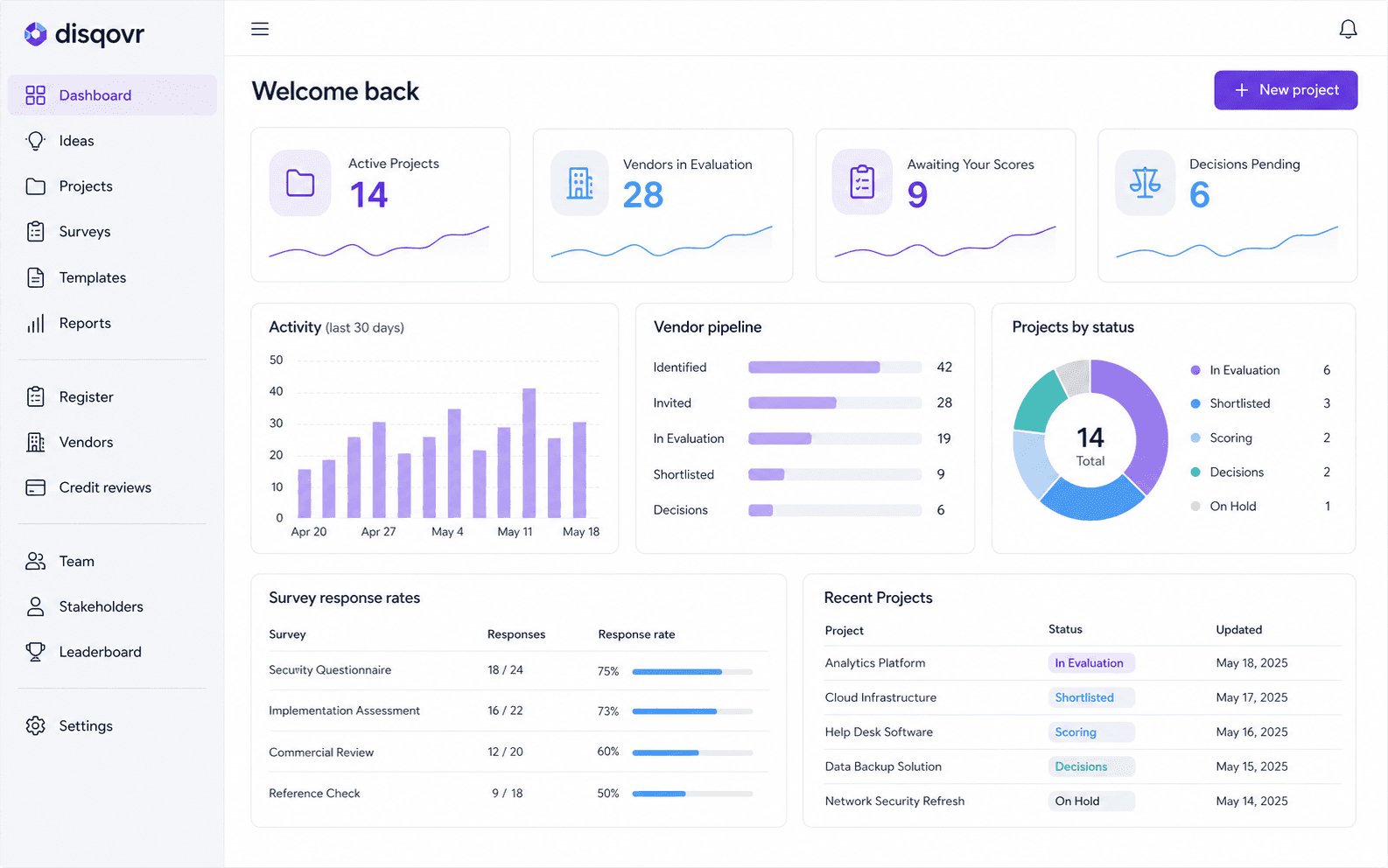
Capture what stakeholders actually need
Before you look at a single vendor, survey the people who'll use the system. Publicly shareable link, no login required. Rating grids capture both importance and satisfaction with the current system. On Pro and above, AI synthesises the free-text answers into a headline, sentiment and the top themes, which you review before they shape the shortlist.
Find vendors from a global directory
Search a shared, community-scored directory of thousands of software vendors, each ready to add with one click. See anonymised community scores from organisations that have already evaluated each vendor, aggregated from real RFIs and demos.
Score the demo while it's fresh
Your team scores each demo independently on UI/UX, mobile, AI and navigation. Everyone scores before discussion so you capture real independent reactions. Vendors with poor demo scores are filtered before you waste weeks on an RFI.
Send a structured capabilities questionnaire
Build a requirements template once, send it to every shortlisted vendor. Vendors complete it in a branded secure portal. No account required. Structured answers (Out of the box / Requires development / Planned / Doesn't do it) make comparison instant.
Let end-users verify what vendors claim
During sandpit access or trial, your actual users score specific tasks. Everyone scores their own workflow independently. Aggregate by role, team, or department. Surface disagreement between power users and occasional users before you sign.
Make a defensible, auditable decision
Survey insights, demo scores, RFI responses, and user testing combine into one weighted scorecard. Every score is traceable back to an individual response. On Pro and above, AI drafts your selection rationale and a board-ready business case from those real scores, as a first draft you edit, never an auto-decision. The final decision has a paper trail that holds up to board-level scrutiny.
Close the loop after go-live
Auto-generated from your Stage 1 requirements. Send to the same stakeholders 3–6 months post-launch. Did the chosen vendor deliver on what they asked for? NPS score. Capability-by-capability comparison. The loop is closed.
Questions about the process
How does Disqovr work?
Disqovr runs a software evaluation as seven stages in one place: a stakeholder requirements survey, vendor research against a shared directory, independently scored demos, a structured RFI answered by vendors in their own portal, end-user testing on the finalists, a weighted report that combines all of it, and a post-launch survey that checks the chosen vendor delivered. Every score stays traceable to the person who gave it.
How long does a software evaluation take with Disqovr?
It depends on the category and how disciplined the team is, but most evaluations land in four to eight weeks: roughly a week for the requirements survey and vendor longlist, two to three weeks for demos and RFI responses, a week for end-user testing on the finalists, and a week to reach the decision. Disqovr does not shorten that by removing rigour. It shortens it by removing the spreadsheet and inbox work between the stages.
Do stakeholders and vendors need a Disqovr account?
No. Stakeholders answer the requirements survey and score demos through a shareable link with no account creation. Vendors answer the RFI in a branded portal reached with a single-use, expiring code sent to their invited email address. Only your own team members log in as workspace users.
Can I start using Disqovr partway through an evaluation?
Yes. An evaluation can be scoped to discovery only, discovery plus demos, the full process, or the RFI alone if the upstream work has already been done elsewhere. Stages you do not need can be switched off in project settings, and the final report weights only what you actually ran.
How does Disqovr stop the loudest voice deciding?
Everyone scores independently before anyone discusses the vendor. Demo scores are captured per attendee, end-user testing is scored per person against their own workflow, and the aggregate report shows variance, so disagreement between power users and occasional users is visible rather than averaged away.
Ready to start?
Run your first evaluation in minutes.
14-day free trial. No credit card. No procurement team required.